
My Grandma Hettie's 1900's Life
In her own words

My great-grandmother’s life spanned most of the 20th century, from 1911 to 2002, just a peep into the 21st century. Hettie was raised by parents and grandparents who were born and raised in the 1800s. They were hardworking farmers who moved further west/northwest with each successive generation—from Ohio and Arkansas to Missouri, to Idaho. Her grandparents could have told her stories about the Great Rebellion, or the War Between the States they experienced as children.
Hettie was a baby when the Titanic sank, dabbled in flapper fashion as a teenager, married just as the Great Depression kicked off, worked a farm with her husband through World War 2, and lived to witness the dawn of the internet age and the tragedy of 9/11. She experienced the terms of 17 US Presidents, from William Taft to George W Bush (including the term of her 3rd cousin, LBJ, of which connection she had no idea during her lifetime!) To her, these major world events were just background noise to her story of a quiet life spent with her hands in the dirt, raising food, flowers and children.
I was blessed to spend time with her and hear many of her stories. Like the one where, as a teenager, she was seated next to Lucille Ball on a train. Being the same age, they became fast friends for the duration of the journey. As Grandma told it, Lucy valiantly tried to talk my grandma into going with her to pursue her fame and fortune as an actress, but Hettie was invested in her own life back home in Idaho.
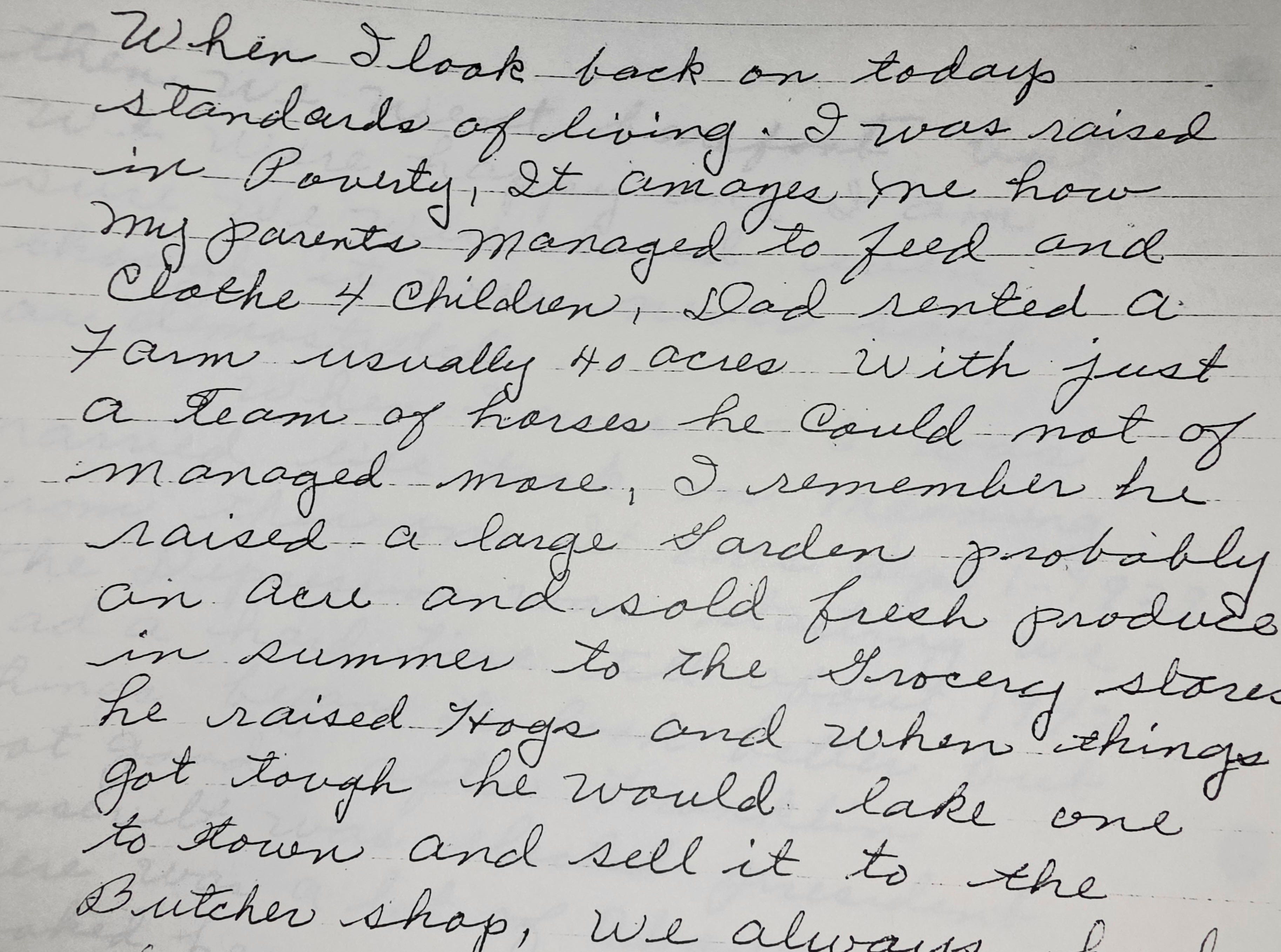
Grandma Hettie didn’t just tell us her stories, she also wrote many of them down. I treasure a manila envelope containing copies of these stories, written in her own handwriting. Many of them sound a lot more like “Little House in the Prairie” than anything resembling today! Here’s a recollection Hettie wrote about the journey of her life:
When I look back, on today’s standards of living, I was raised in poverty. It amazes me how my parents managed to feed and clothe 4 children. Dad rented a farm, usually 40 acres. With just a team of horses, he could not have managed more. I remember he raised a large garden, probably an acre, and sold fresh produce in summer to the grocery stores. He raised hogs and when things got tough he would take one to town and sell it to the Butcher shop. We always had plenty to eat. Not fancy food, but nourishing. Lots of dry beans and potatoes. We usually had a few new clothes and shoes and stockings to start school. Mother made all of my and her clothes, plus shirts for Dad and the boys. I can remember by spring our shoes looked bad. One year I wore cardboard inside mine for weeks to finish school, then we went barefoot. But we were happy and I am sure we were loved even though it was never said or demonstrated.
When I was 18, I was married. Life took on meaning from then on. It was Sept 1, 1929. The Depression was starting. We had a hard time till about 1942. Things began to look better but not good. After Franklin Roosevelt was elected president, there was a lot of changes. People looked happier and had more to look forward to.
When I was 25 years old we had our 3rd child. We now had 2 daughters and one son and the challenge of raising them. Those were happy and skimpy years. In 1942 (February) we moved to Buhl and were happier than when we lived in Rupert. But we still had a hard time making a living. The first 40 acre farm was very poor and not much of a house, but we did not have much furniture anyhow.
Then we rented a better 40 acre farm. From there, on New Years day 1944, we moved to the 80 acre farm. We had skimped to make the $1,000 farm payment. We both worked the first 2 winters to make a living. We worked in the Bean House. I picked beans, Arthur worked in the warehouse. We got the farm for $9000, but it was many years before we paid it off.
The girls and Gene [her kids] and I picked potatoes every fall. I picked for 6 weeks most years and helped pay bills. In the spring, I cut potatoes for 2 or 3 weeks. The years on the farm were hard but enjoyable. Then one by one the children grew up and left home and we were left alone to farm the 80 acres. In the winter of 1967 we rented the farm and moved into town. A different kind of life, but more profitable. We both worked and were able to buy some things for the home that we never could before, such as color TV, washer and dryer, deep freeze, new table and chairs, bed room set, stereo and start to save a little money. But the farm was a good place to raise our family.
Eventually, Hettie and Arthur moved to Arizona to be close to one of their daughters. They celebrated their 70th wedding anniversary before Arthur passed away, and Hettie went to be with him a couple years later. She remained bright and mentally sharp until the end.
A full life, spanning nearly a century. My personal link to events and family member’s lives that are now approaching almost 200 years in the past. My connection to a time when life was manual and materially austere, but also real and deeply engaged.
When I read Grandma Hettie’s stories, I am struck by the level of detail she noticed and remembered. In her story about her family’s move to Idaho when she was barely 7 years old, she recalled every aspect of the journey, including the details of which food they ate on which day, and the emotions everybody was experiencing:
We came to Idaho in the Early Spring of 1918, by train. We kids were very excited about the trip. The last two days and nights we spent with Grandma and Grandpa Butler, mom’s parents.
The day we were to leave, Grandma and my three aunts and mother were very busy fixing us a lunch to take along. We were to be on the train three days and three nights. In those days there were no lunch cars. They fried chicken for the first day, made jelly and apple butter sandwiches, cake and pickles for day two and three. We kids were always hungry and mother warned us we had to make the food last. The last morning we were down to cake and pickles for breakfast. I don’t think Mom and Dad ate very much trying to save it for us four hungry kids.
After a tearful goodbye, we had to travel by horse and wagon about eight miles to get to the train, which left about dark. My uncle Neeley took us and he had to return after dark. We were waiting for the train and when I saw the big, big lights and noisy engine coming at us, I was so frightened I ran and grabbed Dad by both legs. My brother George was scared and crying. We were sure it was going to run over us. We had never seen a train before this.
We were all happy to get to Rupert Idaho and be met by Uncle William, also a wagon drawn by horses. When we got to his home, Aunt Winnie and several cousins were waiting to welcome us with a big pot of navy beans, mashed potatoes, corn bread and peach cobbler. Did we ever enjoy the feast! Mom and Dad really enjoyed the hot coffee she served them. After not having any for three days, it was a treat for them.
By contrast, my memories from the age of seven are brief snatches of vague moments in time. I couldn’t tell you exactly what I ate for any significant meal or which uncle drove us where, in what type of vehicle. Perhaps this is because modern life bombards us with so many ideas and experiences that aren’t even ours that we lose touch with our own lives. Our brains can only hold so much. When we spend hours a day filling our minds with everything happening to everybody else around the world, through social media and 24/7 access to the news, YouTube, podcasts, etc., those things can steal our presence and attention from the very real world at our fingertips.
Hettie’s life was small and insignificant to the wider world, but it was everything to her. She really lived it, noticed it, cherished it and took time to preserve it for future generations to look back on and appreciate. I love that this woman—without whom, I would not exist—continues to offer me a legacy of wisdom even decades after her passing.
Her very present life. Her passion for the small, tangible things that brought her joy. In closing, here is how Hettie felt about flowers:
I started raising roses after we bought our farm. Arthur got a special one each year for me for Mothers Day, and I really loved them but fought quack grass all spring and summer. One day, Dale, my son-in-law asked me why I worked so hard in my flowers. After thinking for a while I told him it was good for my soul. I could be feeling blue and sad because my grandchildren were all so far away, also my children. After an hour among my flowers I always felt better.